Category: Tenders
Hidden Inconsistencies in Government Tender Documents: 12 Cases
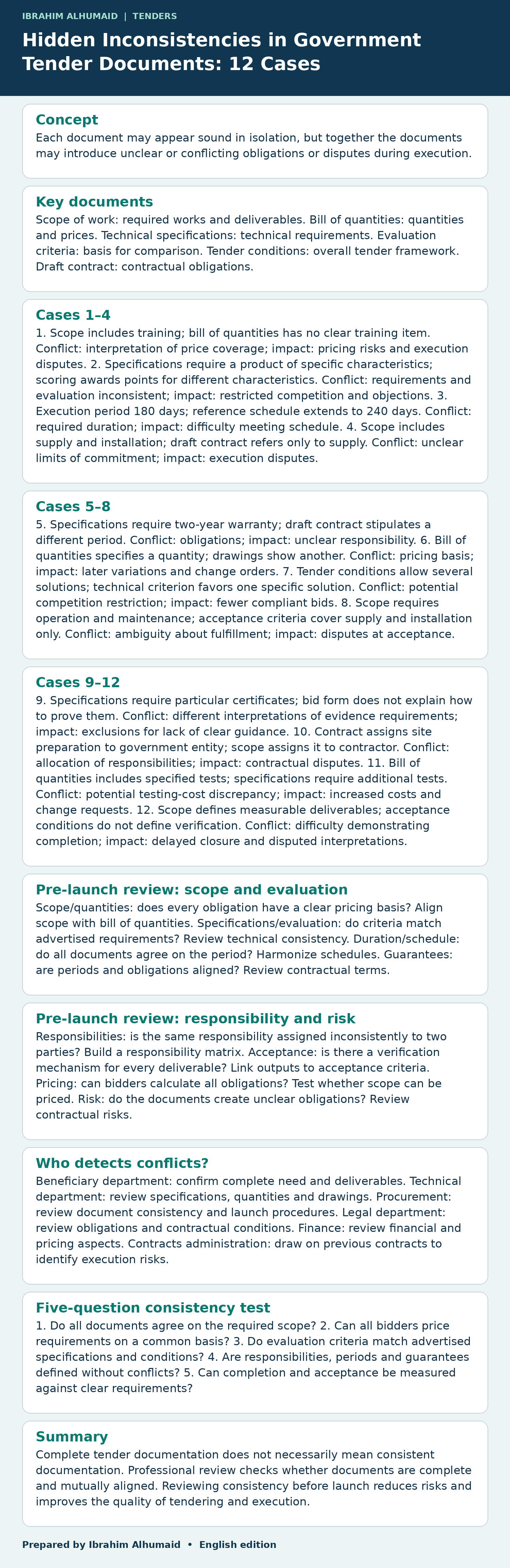
English transcript
Concept
Each document may appear sound in isolation, but together the documents may introduce unclear or conflicting obligations or disputes during execution.
Key documents
Scope of work: required works and deliverables. Bill of quantities: quantities and prices. Technical specifications: technical requirements. Evaluation criteria: basis for comparison. Tender conditions: overall tender framework. Draft contract: contractual obligations.
Cases 1–4
1. Scope includes training; bill of quantities has no clear training item. Conflict: interpretation of price coverage; impact: pricing risks and execution disputes. 2. Specifications require a product of specific characteristics; scoring awards points for different characteristics. Conflict: requirements and evaluation inconsistent; impact: restricted competition and objections. 3. Execution period 180 days; reference schedule extends to 240 days. Conflict: required duration; impact: difficulty meeting schedule. 4. Scope includes supply and installation; draft contract refers only to supply. Conflict: unclear limits of commitment; impact: execution disputes.
Cases 5–8
5. Specifications require two-year warranty; draft contract stipulates a different period. Conflict: obligations; impact: unclear responsibility. 6. Bill of quantities specifies a quantity; drawings show another. Conflict: pricing basis; impact: later variations and change orders. 7. Tender conditions allow several solutions; technical criterion favors one specific solution. Conflict: potential competition restriction; impact: fewer compliant bids. 8. Scope requires operation and maintenance; acceptance criteria cover supply and installation only. Conflict: ambiguity about fulfillment; impact: disputes at acceptance.
Cases 9–12
9. Specifications require particular certificates; bid form does not explain how to prove them. Conflict: different interpretations of evidence requirements; impact: exclusions for lack of clear guidance. 10. Contract assigns site preparation to government entity; scope assigns it to contractor. Conflict: allocation of responsibilities; impact: contractual disputes. 11. Bill of quantities includes specified tests; specifications require additional tests. Conflict: potential testing-cost discrepancy; impact: increased costs and change requests. 12. Scope defines measurable deliverables; acceptance conditions do not define verification. Conflict: difficulty demonstrating completion; impact: delayed closure and disputed interpretations.
Pre-launch review: scope and evaluation
Scope/quantities: does every obligation have a clear pricing basis? Align scope with bill of quantities. Specifications/evaluation: do criteria match advertised requirements? Review technical consistency. Duration/schedule: do all documents agree on the period? Harmonize schedules. Guarantees: are periods and obligations aligned? Review contractual terms.
Pre-launch review: responsibility and risk
Responsibilities: is the same responsibility assigned inconsistently to two parties? Build a responsibility matrix. Acceptance: is there a verification mechanism for every deliverable? Link outputs to acceptance criteria. Pricing: can bidders calculate all obligations? Test whether scope can be priced. Risk: do the documents create unclear obligations? Review contractual risks.
Who detects conflicts?
Beneficiary department: confirm complete need and deliverables. Technical department: review specifications, quantities and drawings. Procurement: review document consistency and launch procedures. Legal department: review obligations and contractual conditions. Finance: review financial and pricing aspects. Contracts administration: draw on previous contracts to identify execution risks.
Five-question consistency test
1. Do all documents agree on the required scope? 2. Can all bidders price requirements on a common basis? 3. Do evaluation criteria match advertised specifications and conditions? 4. Are responsibilities, periods and guarantees defined without conflicts? 5. Can completion and acceptance be measured against clear requirements?
Summary
Complete tender documentation does not necessarily mean consistent documentation. Professional review checks whether documents are complete and mutually aligned. Reviewing consistency before launch reduces risks and improves the quality of tendering and execution.