Category: Tenders
Objections and Grievances in Government Tenders
Glossary · Contract Award and Contract Signing · Pre-Award Grievance and Award Grievance
Read the full English text and references
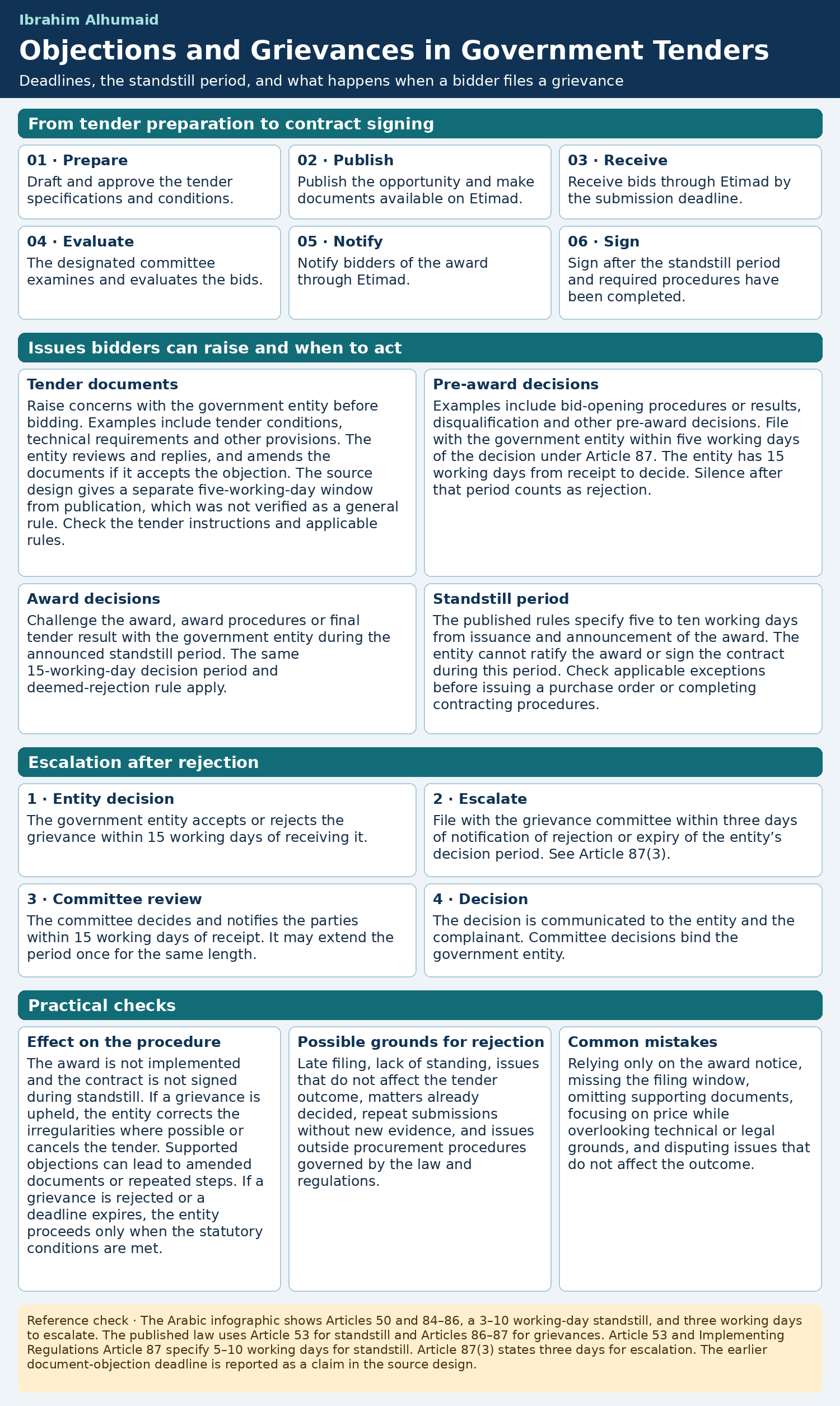
From tender preparation to contract signing
01 · Prepare
Draft and approve the tender specifications and conditions.
02 · Publish
Publish the opportunity and make documents available on Etimad.
03 · Receive
Receive bids through Etimad by the submission deadline.
04 · Evaluate
The designated committee examines and evaluates the bids.
05 · Notify
Notify bidders of the award through Etimad.
06 · Sign
Sign after the standstill period and required procedures have been completed.
Issues bidders can raise and when to act
Tender documents
Raise concerns with the government entity before bidding. Examples include tender conditions, technical requirements and other provisions. The entity reviews and replies, and amends the documents if it accepts the objection. The source design gives a separate five-working-day window from publication, which was not verified as a general rule. Check the tender instructions and applicable rules.
Pre-award decisions
Examples include bid-opening procedures or results, disqualification and other pre-award decisions. File with the government entity within five working days of the decision under Article 87. The entity has 15 working days from receipt to decide. Silence after that period counts as rejection.
Award decisions
Challenge the award, award procedures or final tender result with the government entity during the announced standstill period. The same 15-working-day decision period and deemed-rejection rule apply.
Standstill period
The published rules specify five to ten working days from issuance and announcement of the award. The entity cannot ratify the award or sign the contract during this period. Check applicable exceptions before issuing a purchase order or completing contracting procedures.
Escalation after rejection
1 · Entity decision
The government entity accepts or rejects the grievance within 15 working days of receiving it.
2 · Escalate
File with the grievance committee within three days of notification of rejection or expiry of the entity’s decision period. See Article 87(3).
3 · Committee review
The committee decides and notifies the parties within 15 working days of receipt. It may extend the period once for the same length.
4 · Decision
The decision is communicated to the entity and the complainant. Committee decisions bind the government entity.
Practical checks
Effect on the procedure
The award is not implemented and the contract is not signed during standstill. If a grievance is upheld, the entity corrects the irregularities where possible or cancels the tender. Supported objections can lead to amended documents or repeated steps. If a grievance is rejected or a deadline expires, the entity proceeds only when the statutory conditions are met.
Possible grounds for rejection
Late filing, lack of standing, issues that do not affect the tender outcome, matters already decided, repeat submissions without new evidence, and issues outside procurement procedures governed by the law and regulations.
Common mistakes
Relying only on the award notice, missing the filing window, omitting supporting documents, focusing on price while overlooking technical or legal grounds, and disputing issues that do not affect the outcome.
Reference check · The Arabic infographic shows Articles 50 and 84–86, a 3–10 working-day standstill, and three working days to escalate. The published law uses Article 53 for standstill and Articles 86–87 for grievances. Article 53 and Implementing Regulations Article 87 specify 5–10 working days for standstill. Article 87(3) states three days for escalation. The earlier document-objection deadline is reported as a claim in the source design.
Government Tenders and Procurement Law · Implementing Regulations (Ministry of Finance)