Category: Tenders
Tender Specification Errors: How to Address Them Before and After Contract Signing
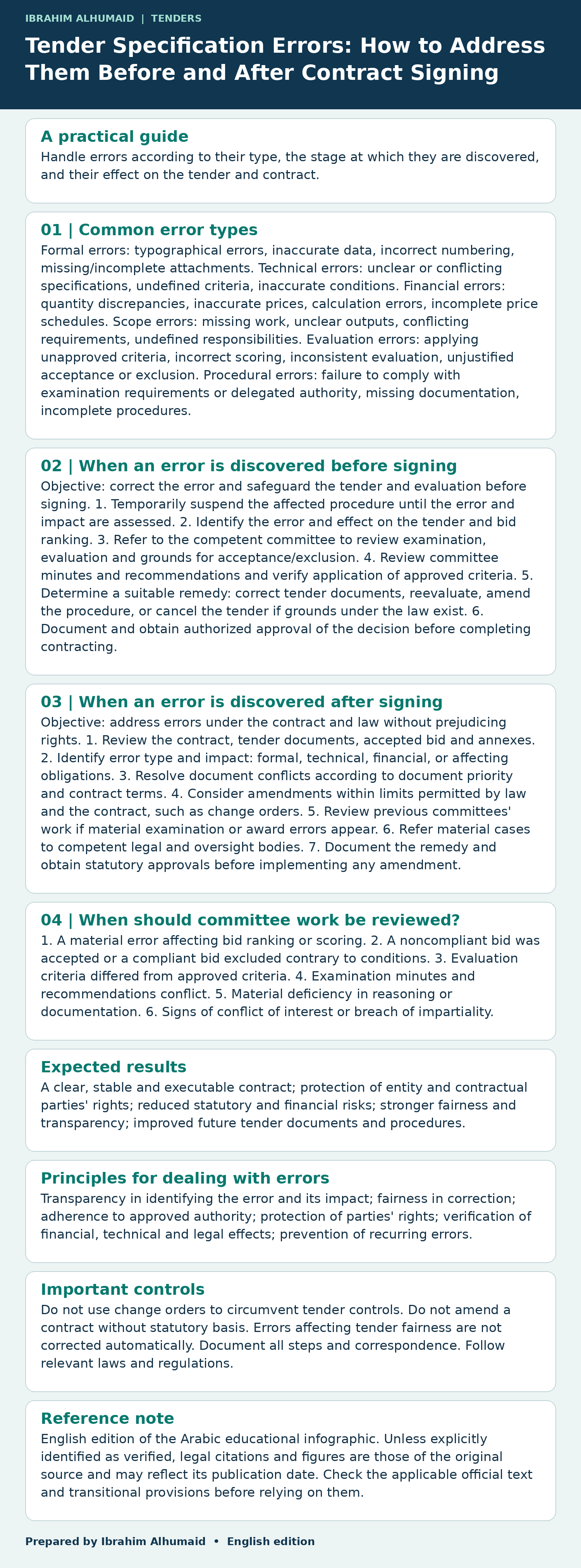
English transcript
A practical guide
Handle errors according to their type, the stage at which they are discovered, and their effect on the tender and contract.
01 | Common error types
Formal errors: typographical errors, inaccurate data, incorrect numbering, missing/incomplete attachments. Technical errors: unclear or conflicting specifications, undefined criteria, inaccurate conditions. Financial errors: quantity discrepancies, inaccurate prices, calculation errors, incomplete price schedules. Scope errors: missing work, unclear outputs, conflicting requirements, undefined responsibilities. Evaluation errors: applying unapproved criteria, incorrect scoring, inconsistent evaluation, unjustified acceptance or exclusion. Procedural errors: failure to comply with examination requirements or delegated authority, missing documentation, incomplete procedures.
02 | When an error is discovered before signing
Objective: correct the error and safeguard the tender and evaluation before signing. 1. Temporarily suspend the affected procedure until the error and impact are assessed. 2. Identify the error and effect on the tender and bid ranking. 3. Refer to the competent committee to review examination, evaluation and grounds for acceptance/exclusion. 4. Review committee minutes and recommendations and verify application of approved criteria. 5. Determine a suitable remedy: correct tender documents, reevaluate, amend the procedure, or cancel the tender if grounds under the law exist. 6. Document and obtain authorized approval of the decision before completing contracting.
03 | When an error is discovered after signing
Objective: address errors under the contract and law without prejudicing rights. 1. Review the contract, tender documents, accepted bid and annexes. 2. Identify error type and impact: formal, technical, financial, or affecting obligations. 3. Resolve document conflicts according to document priority and contract terms. 4. Consider amendments within limits permitted by law and the contract, such as change orders. 5. Review previous committees' work if material examination or award errors appear. 6. Refer material cases to competent legal and oversight bodies. 7. Document the remedy and obtain statutory approvals before implementing any amendment.
04 | When should committee work be reviewed?
1. A material error affecting bid ranking or scoring. 2. A noncompliant bid was accepted or a compliant bid excluded contrary to conditions. 3. Evaluation criteria differed from approved criteria. 4. Examination minutes and recommendations conflict. 5. Material deficiency in reasoning or documentation. 6. Signs of conflict of interest or breach of impartiality.
Expected results
A clear, stable and executable contract; protection of entity and contractual parties' rights; reduced statutory and financial risks; stronger fairness and transparency; improved future tender documents and procedures.
Principles for dealing with errors
Transparency in identifying the error and its impact; fairness in correction; adherence to approved authority; protection of parties' rights; verification of financial, technical and legal effects; prevention of recurring errors.
Important controls
Do not use change orders to circumvent tender controls. Do not amend a contract without statutory basis. Errors affecting tender fairness are not corrected automatically. Document all steps and correspondence. Follow relevant laws and regulations.
Reference note
English edition of the Arabic educational infographic. Unless explicitly identified as verified, legal citations and figures are those of the original source and may reflect its publication date. Check the applicable official text and transitional provisions before relying on them.