Procurement, Contract and Supplier Data Analytics
Theory of Constraints (TOC): How to Identify the Real Bottleneck in Government Procurement and Contracts
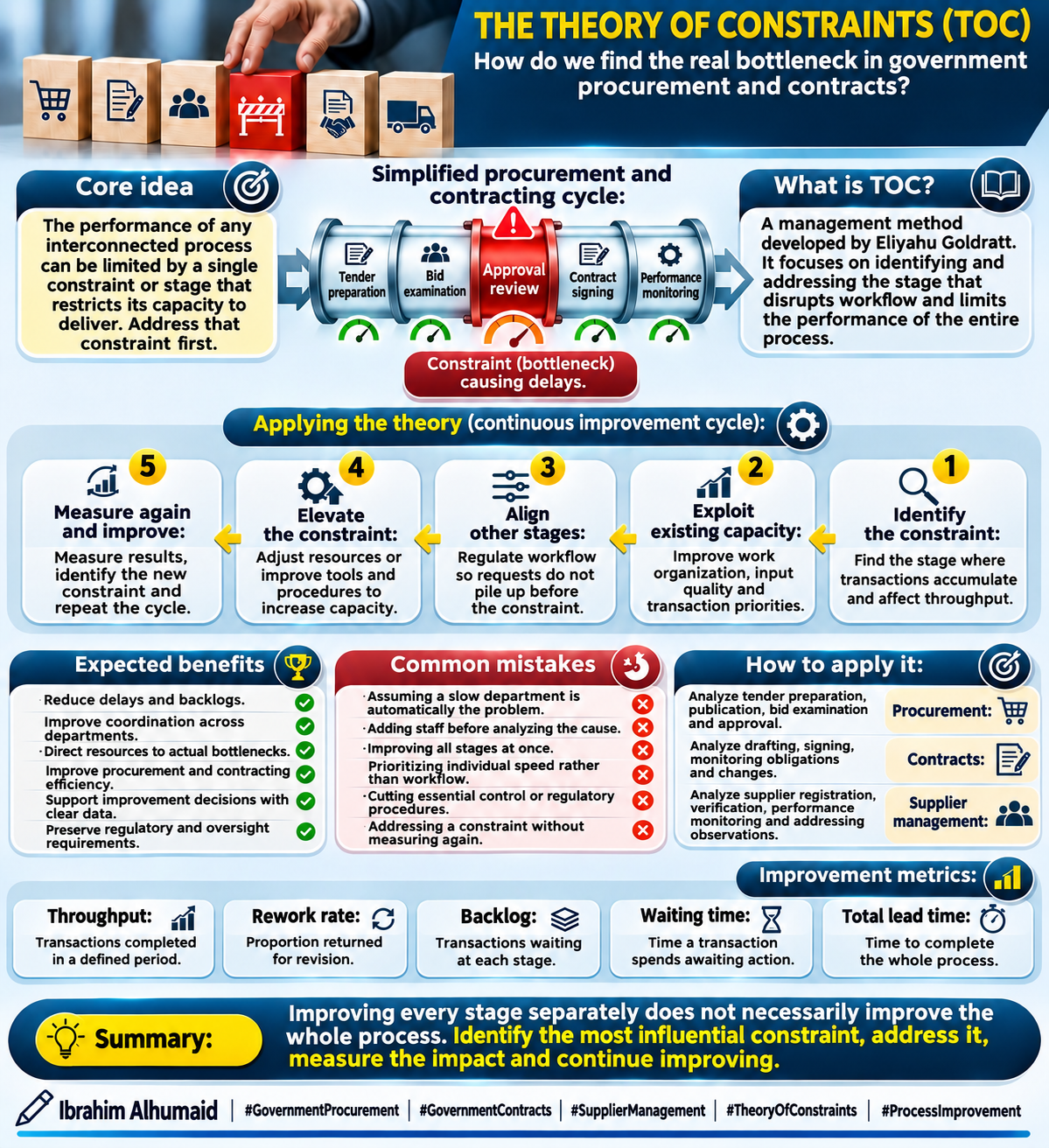
English transcript
What is the Theory of Constraints?
A management method developed by Eliyahu Goldratt. It focuses on identifying and addressing the stage that disrupts workflow and limits overall process performance.
Core idea
The performance of any interconnected process can be limited by a single constraint or stage that restricts its capacity to deliver. Focus on addressing that constraint first.
Simplified procurement and contracting cycle
Tender preparation → Bid examination → Approval review (the bottleneck causing delay) → Contract signing → Performance monitoring.
Applying the theory: continuous improvement cycle
1. Identify the constraint: Find the stage where transactions accumulate and affect throughput.
2. Exploit existing capacity: Improve work organization, input quality and transaction priorities.
3. Align the other stages: Regulate workflow so requests do not pile up before the constraint.
4. Elevate the constraint: Adjust resources or improve tools and procedures to increase capacity.
5. Measure again and improve: Measure results, identify the new constraint and repeat the improvement cycle.
How to apply it in our field
Procurement: Analyze the stages of tender preparation, publication, bid examination and approval.
Contracts: Analyze contract drafting and signing, and monitor obligations and changes.
Supplier management: Analyze supplier registration, verification, performance monitoring and handling observations.
Common mistakes
Assuming a slow department is automatically the problem.
Adding staff before analyzing the cause.
Improving every stage at once.
Focusing on individual speed instead of workflow.
Cutting essential regulatory and oversight procedures.
Addressing the constraint without measuring again.
Expected benefits
Reduce delays and backlogs.
Improve coordination across departments.
Direct resources to actual bottlenecks.
Improve the efficiency of procurement and contracting procedures.
Support improvement decisions with clear data.
Preserve regulatory and oversight requirements.
Improvement metrics
Total lead time: Time to complete the entire process.
Waiting time: Time a transaction spends awaiting action.
Backlog: Number of transactions waiting at each stage.
Rework rate: Proportion of transactions returned for revision.
Throughput: Number of transactions completed in a defined period.
Summary
Improving each stage separately does not necessarily improve the performance of the entire process. Identify the most influential constraint, address it, measure the impact and continue improving.
Prepared by Ibrahim Alhumaid
#GovernmentProcurement #GovernmentContracts #SupplierManagement #TheoryOfConstraints #ProcessImprovement