Category: Data Analytics
Using Root Cause Analysis to Address Delays
Try the case in the Decision Lab
Read the full English text
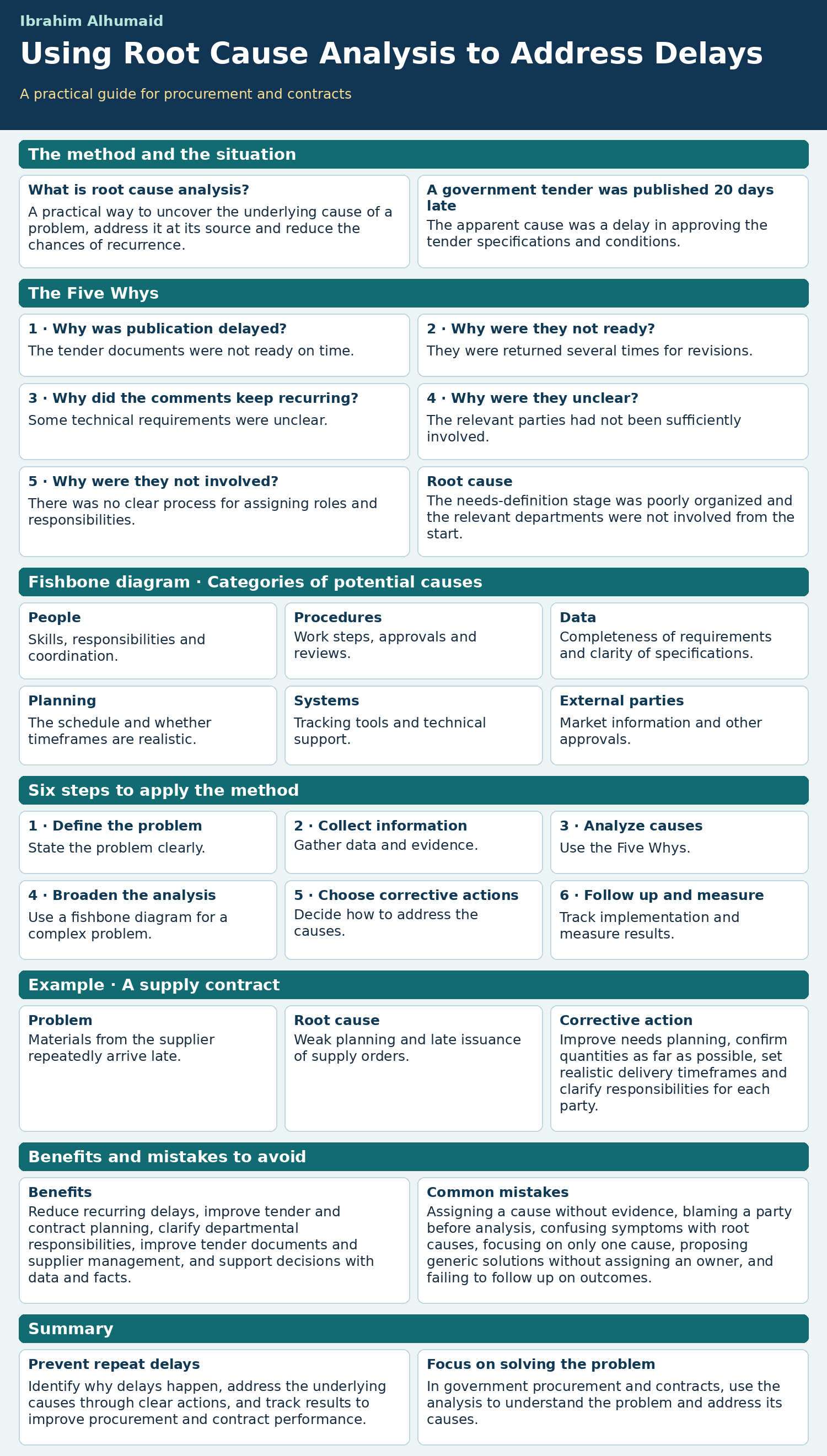
The method and the situation
What is root cause analysis?
A practical way to uncover the underlying cause of a problem, address it at its source and reduce the chances of recurrence.
A government tender was published 20 days late
The apparent cause was a delay in approving the tender specifications and conditions.
The Five Whys
1 · Why was publication delayed?
The tender documents were not ready on time.
2 · Why were they not ready?
They were returned several times for revisions.
3 · Why did the comments keep recurring?
Some technical requirements were unclear.
4 · Why were they unclear?
The relevant parties had not been sufficiently involved.
5 · Why were they not involved?
There was no clear process for assigning roles and responsibilities.
Root cause
The needs-definition stage was poorly organized and the relevant departments were not involved from the start.
Fishbone diagram · Categories of potential causes
People
Skills, responsibilities and coordination.
Procedures
Work steps, approvals and reviews.
Data
Completeness of requirements and clarity of specifications.
Planning
The schedule and whether timeframes are realistic.
Systems
Tracking tools and technical support.
External parties
Market information and other approvals.
Six steps to apply the method
1 · Define the problem
State the problem clearly.
2 · Collect information
Gather data and evidence.
3 · Analyze causes
Use the Five Whys.
4 · Broaden the analysis
Use a fishbone diagram for a complex problem.
5 · Choose corrective actions
Decide how to address the causes.
6 · Follow up and measure
Track implementation and measure results.
Example · A supply contract
Problem
Materials from the supplier repeatedly arrive late.
Root cause
Weak planning and late issuance of supply orders.
Corrective action
Improve needs planning, confirm quantities as far as possible, set realistic delivery timeframes and clarify responsibilities for each party.
Benefits and mistakes to avoid
Benefits
Reduce recurring delays, improve tender and contract planning, clarify departmental responsibilities, improve tender documents and supplier management, and support decisions with data and facts.
Common mistakes
Assigning a cause without evidence, blaming a party before analysis, confusing symptoms with root causes, focusing on only one cause, proposing generic solutions without assigning an owner, and failing to follow up on outcomes.
Summary
Prevent repeat delays
Identify why delays happen, address the underlying causes through clear actions, and track results to improve procurement and contract performance.
Focus on solving the problem
In government procurement and contracts, use the analysis to understand the problem and address its causes.